Fragrance Education · Structure
How to Read a Fragrance Pyramid
Top notes, heart notes, base notes — what they mean, how they evolve, and why you should wait before judging a perfume.
Every perfume tells a story — and like all great stories, it unfolds in layers. The fragrance pyramid is the storytelling structure of perfumery: a visual model that shows how a scent evolves over time, from your first spray to hours later. Understanding it is the single most important skill a fragrance enthusiast can develop.
What Is the Fragrance Pyramid?
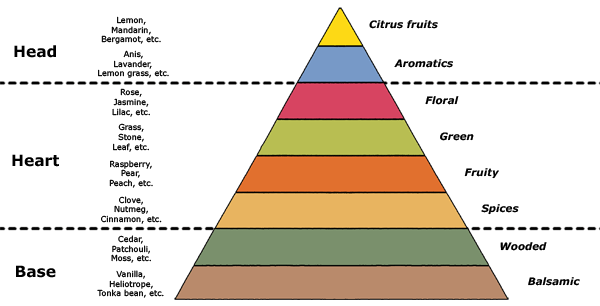
The fragrance pyramid divides a perfume’s composition into three layers, each containing ingredients that evaporate at different rates. Perfumers use this structure intentionally — they’re designing a temporal experience, not just a static smell.
The Three Layers
Top Notes — The First Impression
Top notes are what you smell immediately upon spraying. They’re the most volatile ingredients, evaporating within 15 to 30 minutes. They are designed to attract attention and create a positive first impression — but they’re not meant to represent the full character of the perfume.
Heart Notes — The True Character
After the top notes fade, the heart emerges. This is the core of the fragrance — the part that defines its identity and olfactory family. Heart notes typically last between 30 minutes and several hours. If you’ve ever loved how a perfume smelled on someone who’d been wearing it all day, you were experiencing the heart and base, not the top.
Base Notes — The Lasting Memory
Base notes are the foundation of the fragrance — the heaviest, most tenacious ingredients that can last for hours or even days. They serve a dual purpose: they anchor the lighter notes above them, slowing their evaporation, and they provide the lingering trail (or “sillage”) a perfume leaves behind.
How to Experience a Fragrance Pyramid on Your Skin
The key to truly understanding a perfume is time. Spray the fragrance on your wrist or inner elbow — pulse points generate heat that activates the scent. Note your immediate impression: this is the top note.
Wait 20 to 30 minutes without rubbing the skin. Rubbing breaks down the fragrance molecules and interferes with natural evolution. Smell again: you’re now entering the heart.
After two to three hours, smell once more. The fragrance has dried down to its base. This is the scent you’ll carry with you for the rest of the day.
Questions & Answers
Why do some perfumes smell different on my skin than in the bottle?
In the bottle, you’re essentially smelling all layers simultaneously in concentrated form. On skin, heat activates the top notes first, then they evaporate to reveal the heart, then the base. The experience is always different — and almost always better — when worn on skin.
What is “dry-down”?
Dry-down refers to the final stage of fragrance evolution — when the top and heart notes have largely evaporated and only the base remains. It’s often the most intimate and personal-smelling stage, as the fragrance has had time to fully interact with your skin chemistry.
Do all perfumes follow the pyramid structure?
Not always. Some modern fragrances are intentionally “linear” — they smell the same from first spray to dry-down. This is a deliberate creative choice, often seen in minimalist or skin-scent style fragrances. The pyramid model is a useful guide, but perfumers don’t always design with it in mind.
Go Deeper
Map Notes & Accords Interactively
Explore how notes interact across the pyramid in The Perfume Librairie’s olfactory atlas.
Open the Atlas